The Gate of Heracles
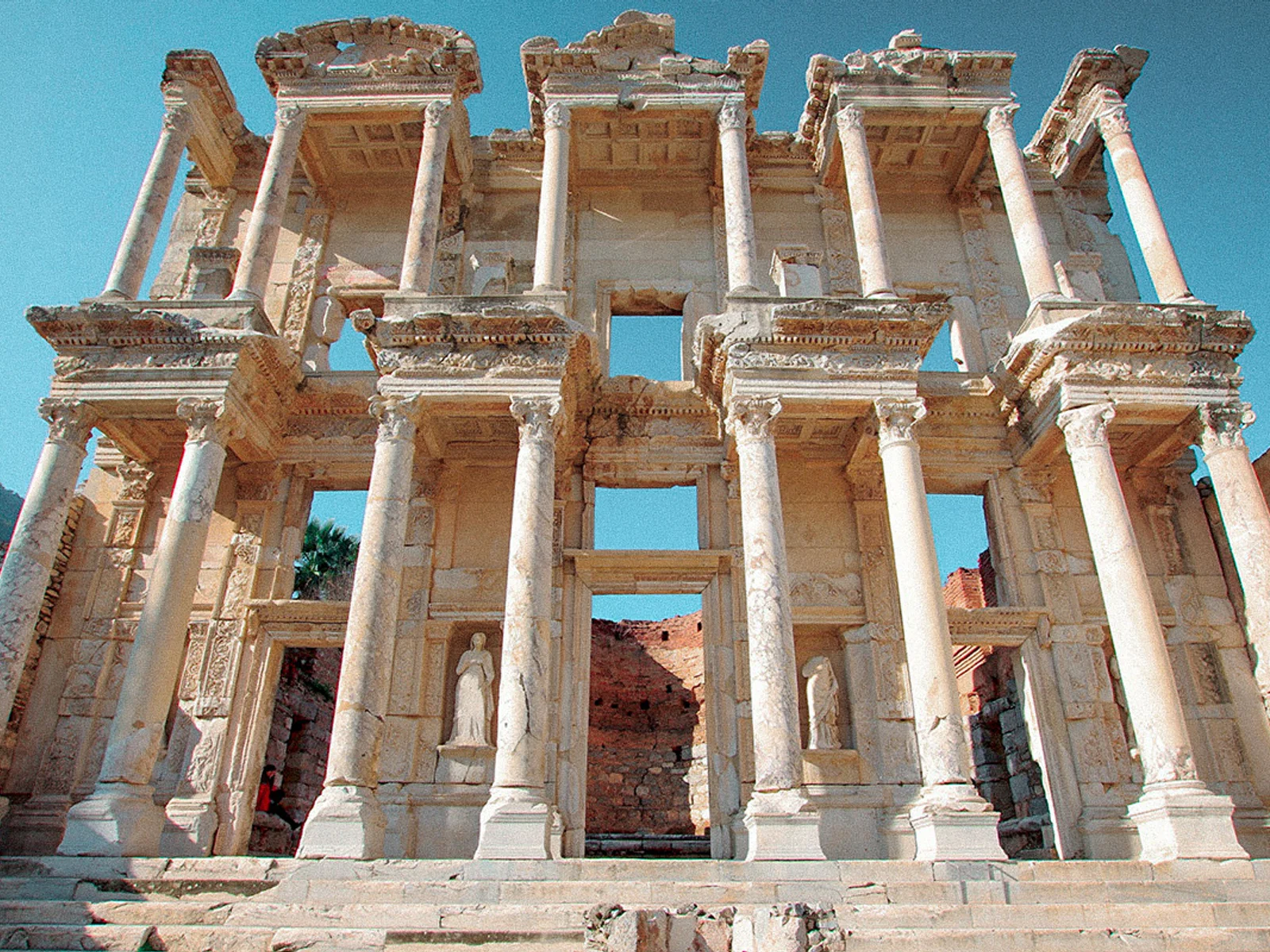
The gate is located at the beginning of Curetes Street. It is a two-storeyed edifice. In the lower storey there is a wide arched passageway, and in the upper storey there are six columns in a row. Reliefs of flying Nikes that are found today in Domitian Square used to be situated at the corners where the arch joins the pillars with Corinthian capitals. One of these reliefs and most of the construction fragments have not yet been found.
The two centrally located columns at the upper level resemble the lintels of the gate. On these two columns, there are two reliefs of Heracles depicted wrapped in a Nemea lion skin. They are like the caryatids supporting Corinthian capitals and exhibit 2nd century craftsmanship. They were moved here in the 5th century from another location.
Sections of Ephesus Guide:
1- Introduction to Ephesus
Ephesus is considered one of the great outdoor museums of Turkey, in fact perhaps of the world. It is located on the south of Izmir's Selcuk county. The links of Ephesus with the Amazons and the myths had survived throughout history.
2- Odeion
This semi-circular structure, known also as the Small Theatre. According to an inscription unearthed, it was built as a bouleuterion (council chamber) around 150 A.D. by Publius Vedius Antonius and his wife FlaviaPapiana.
3- Temples of the Goddess Rome and of Divine Caesar
In the Augustan era, the spread of Imperial-Roman cults was by then a fact in many provinces of Asia Minor. The cult of the Emperor was alive in Nicomedia and in Pergamum, together with that of the Goddess Rome.
4- Prytaneion
The prytaneion was constructed in the 3rd century B.C. and attained its final shape during the reign of Emperor Augustus. After it was destroyed for various reasons, its columns and some of its other architectural elements were used in the construction of the Scholastika Baths.
5- The Pollio Fountain
This is located to the east of Domitian Square, next to the western side of the Agora. With its wide and high arch which supports the triangular pediment and its small pool, it is quite an appealing structure.
6- Temple of Domitian
Ephesus was granted the temple wardenship for the first time by Emperor Domitian (81-96). The temple dedicated to him was built on a terrace measuring 50 by 100 meters on the south side of Domitian Square.
7- The Gate of Heracles
The gate is located at the beginning of Curetes Street. It is a two-storeyed edifice. In the lower storey there is a wide arched passageway, and in the upper storey there are six columns in a row.
8- Curetes Street
In mythology, the Curetes were known as semi-deities. Later "Curetes" referred to a class of priests in Ephesus. Mary inscriptions about the Curetes were discovered in different locations in Ephesus, especially at the Prytaneion.
9- Trajan Fountain
Along the Curetes Street, in a wonderful succession of ancient ruins, sculpted pillars decorated with sculptural figurations, we can see reconstruction on a reduced scale of one of the most remarkable Ephesian monuments.
10- Temple of Hadrian
This is the one of the most attractive edifices on the Curetes Street, and it must have been built at the latest by the year 138. The temple is consist of a monumental pronaos and a small, bare cella.
11- Latriana
The latrina built in the first century A.D. are the public toilets of Ephesus. The toilets were ranged side by side with no partition between them. In the middle was a square pool. The floor was paved with mosaics.
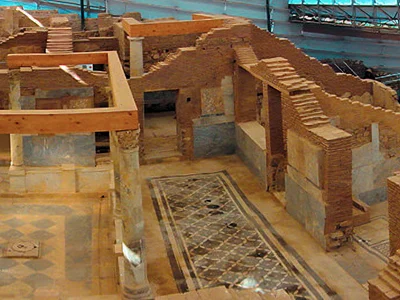
12- Hillside Houses
From the opposite part of the Temple of Hadrian the interesting complex of the so-called "Houses on the slope" faces out onto Curetes Street. These houses were inhibated by the most qualified and wealthy social class and for this reason they are also known as "houses of the rich" or "palaces on the slopes" .
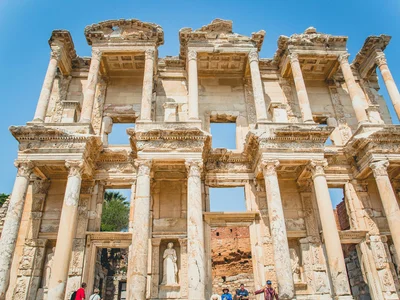
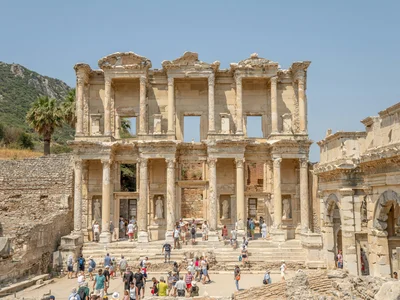
13- Ephesus Library
The building is made of very good marble and decorated with figures of Eros, Nike, rosettes and garlands in relief . The building reflects the characteristics of the age of Emperor Hadrian.
14- Marble Street
This street, which practically constitutes the entrance to the theatre for anyone coming from the Library of Celsus, goes along the western slopes of Mount Panayir, in a zone of considerable architectural interest.
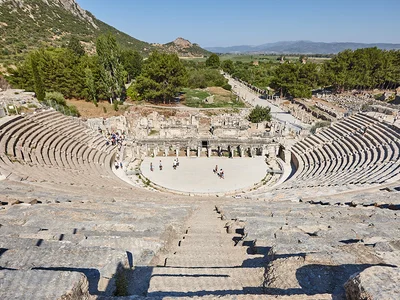
15- Ephesus Theatre
The theatre built on the slopes of Mount Panayir was constructed during the reign of Lysimachos and later it was altered many times. Like all the other ancient theatres, the theatre consisted of three main section.
16- Harbour Street
Harbour street is 500 meters long and 11 metes wide. On both side of the street there were covered particos. These particos, which were reserved for pedestrians, had the function of protecting them from the bad weather and hosted shops in the inner part.
17- Ephesus Indoor Museum
The Museum of Ephesus is in the district of Selcuk, and displays works of art found in the excavations in Ephesus since 1964. The museum was enlarged in 1976 with new buildings and thus reached its present state.
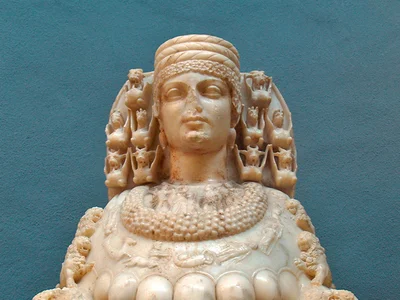
18- Goddess Artemis
The Museum of Ephesus is in the district of Selcuk, and displays works of art found in the excavations in Ephesus since 1964. The museum was enlarged in 1976 with new buildings and thus reached its present state.